



20-robot success
Abstract
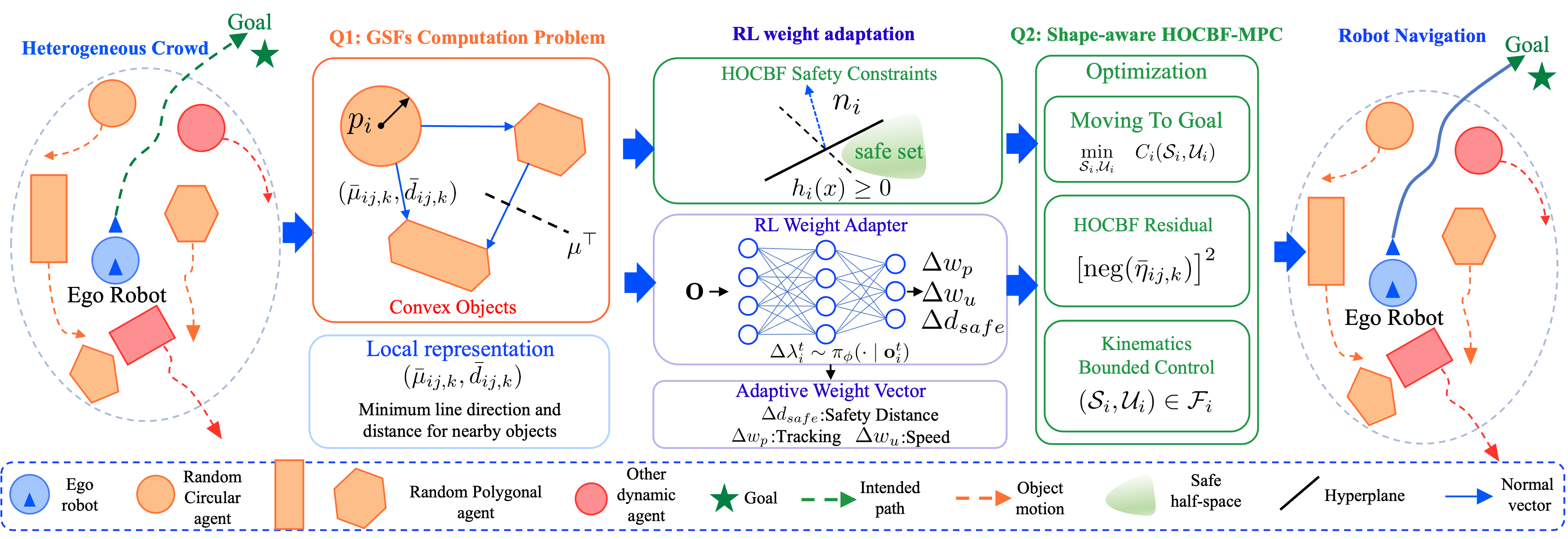
Safe and efficient shape-aware navigation in heterogeneous crowds and robot fleets remains challenging. Traditional approaches often assume homogeneous robots, sparse workspaces, simplified geometry, offline computation, or handcrafted parameters to make the problem tractable, which limits their deployment in dense crowd scenarios. Toward this end, we propose Shape-Aware Reinforcement Learned Model Predictive Control (SRL-MPC), a method for safe, efficient, and adaptive navigation in crowds with heterogeneous shapes without geometry simplification.
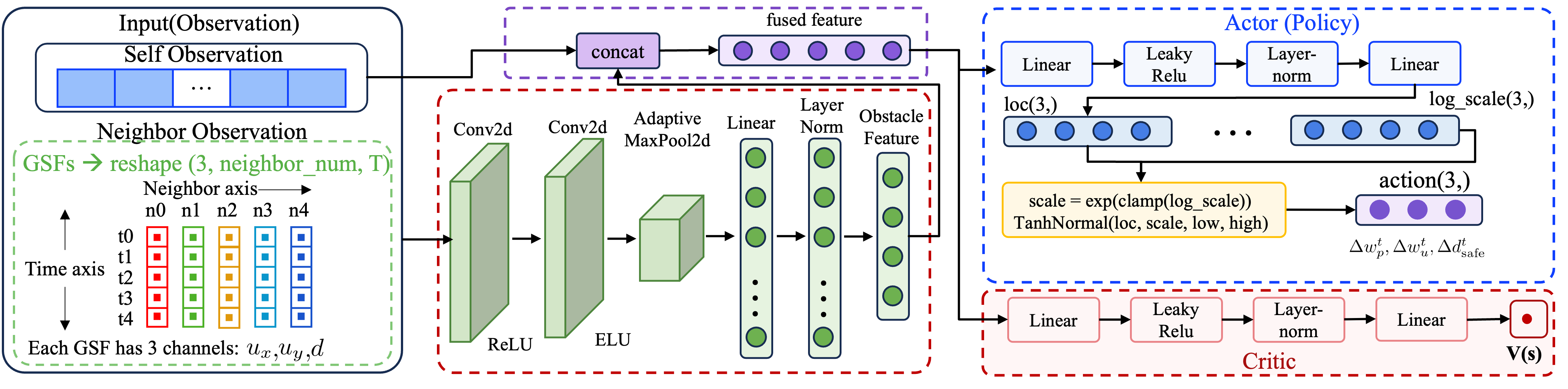
SRL-MPC formulates high-order control barrier function residuals from geometric separation features based on support-function geometry. A reinforcement learning policy reads these local features and produces real-time MPC parameter updates, while the executed controls remain the solution of an explicit model-predictive optimization problem. Randomized crowd experiments with arbitrarily shaped robot fleets demonstrate strong effectiveness, scalability, and robustness, especially as crowd density increases.
Architecture
Key Advantages and Features
1. Shape-aware geometry: compact geometric separation features represent circular and convex-polygon bodies without reducing every robot to a disc.
2. Adaptive planning: each learned policy updates path tracking, control effort, and safety-distance parameters from local crowd geometry.
3. Model-based execution: reinforcement learning tunes the planner; the action is still produced by an explicit local MPC problem with bounded controls.
4. Dense-scene robustness: independently trained policies use the same 15-robot training distribution and are evaluated in dense 20- and 25-robot scenes.
Multi-seed evaluation · 300 episodes per setting
Dense-scene Evaluation
Three independently trained policies, each evaluated for 100 episodes per dense setting. Values report mean ± sample SD across training seeds.
25-robot success
86.7%
±0.6 percentage points across three policies*
Key comparison
+65.7 pp
above SARL at 21%, the strongest external baseline in the 25-robot setting.
25-robot success*
mean over N = 20 and N = 25

25-robot baseline comparison
Success rate| Method | Success |
|---|---|
| SRL-MPC | 86.7 ± 0.6%* |
| SARL | 21% |
| AVOCADO | 11% |
| VO-polytope | 8% |
| ORCA | 7% |
| RL-RVO | 1% |
Rebuttal evaluation · no retraining
Out-of-Distribution Evaluation
Three policies trained independently in the 15-robot random-convex-polygon setting are evaluated without retraining for 100 episodes each in five distribution shifts.
77.5%±2.5 pp · OOD macro across five shifts

Preliminary deployment
Real-World Demonstration
A controlled indoor platform comparison of SRL-MPC with ORCA, distributed MPC, and manually tuned MPC.